
I walked into yesterday’s masterclass as a casual yoga practitioner. Someone who has rolled out a mat, moved through a flow, breathed when told to breathe. I walked out with something I didn’t expect — a quiet revolution in how I understand the practice I thought I already knew.
The masterclass, run by my Yoga Guru Nivriti Gargya, focused on the traditional and classical practice of yoga: Suryanamaskar, Pranayama, and AUM chanting. Three elements I had touched before. But never like this. Never with the why so clearly laid out in front of me.
And that is what baffled me most was not the content itself, but how rarely it is taught.
Is yoga a spiritual practice or exercise?
In this age where knowledge is accessible to everyone, it strikes me how much of yoga’s authentic wisdom is filtered out before it reaches us. Walk into most yoga studios today and you’ll be guided through beautiful sequences, told to “flow with your breath” and “meet your body where it is“. And these are true and good things. But rarely does anyone stop to explain what that actually means.
Like Nivriti says,
“Yoga is not a performance. It is an experience.”
When I first heard that, it landed softly. But yesterday, watching her teach and dismantle 30 minutes of practice into its philosophical bones, I finally understood what she means. The moment you begin performing yoga, the moment you measure yourself against the person on the next mat or chase a perfect posture, you have left yoga entirely. You are doing something else. Something that looks like yoga from the outside but has lost the very thing that makes it profound.
In the Beginning, There Was AUM
What does AUM chanting mean in the context of yoga?
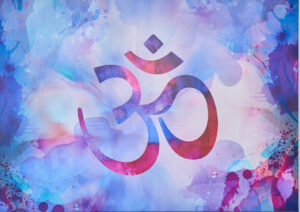
AUM — the sound of the universe. The reverberation that, as ancient tradition holds, may have been the first vibration of existence itself. Perhaps the echo of the Big Bang still humming through us.
AUM is three sounds in one:
- A rises from the navel : the seat of creation, of raw instinct, of Brahma.
- U moves to the chest : the heart, the emotional self, the energy of preservation, of Vishnu.
- M vibrates at the crown of the head : the consciousness, oblivion, transformation, Shiva.
Ideally, each sound is held in equal duration: 1:1:1. The reverberation of these sounds travels upward through the body, from the most primal, animalistic centre to the seat of higher consciousness. AUM, in a single breath, maps out our evolution as beings. From instinct, to emotion, to awareness. It is a journey from inner self to higher self — which is, at its root, what the word yoga means. “Yuj” = to unite self to higher self.
Chanting in yoga is more about the sound and vibration than the words or the lyrics. When we understand that, the practice of beginning or closing a session with AUM shifts entirely. It is not ritual. It is re-calibration.
The Sun That Sees No Difference
What is the spiritual meaning of Surya Namaskar?
If AUM opens us inward, Surya-namaskar (Sun-salutation) orients us outward. Or rather, it uses the outward to return us inward.
The intention embedded in the traditional Suryanamaskar chant is this: Open the golden orb. Shower us with light. Remove the darkness (ignorance) within me. Let me grow in your likeness.
But what moved me most about this teaching was the philosophical invitation within it. The Sun is the great equaliser. It does not distinguish. When it rises, it shines on every being on our planet – plant and animal, on coloured and white, on man and woman and child, on the powerful and the forgotten. It simply shines. Completely. Without bias. It is upto each entity to receive from it.
The practice of Suryanamaskar begins with an intention: let me be like the sun. Unbiased. Equal. A practitioner who sets this intention before their first inhale is not just warming up their body. They are setting the tone for how they wish to move through the world that day.
The Five Layers of a Single Sun Salutation
A deep dive into the practice of Suryanamaskar
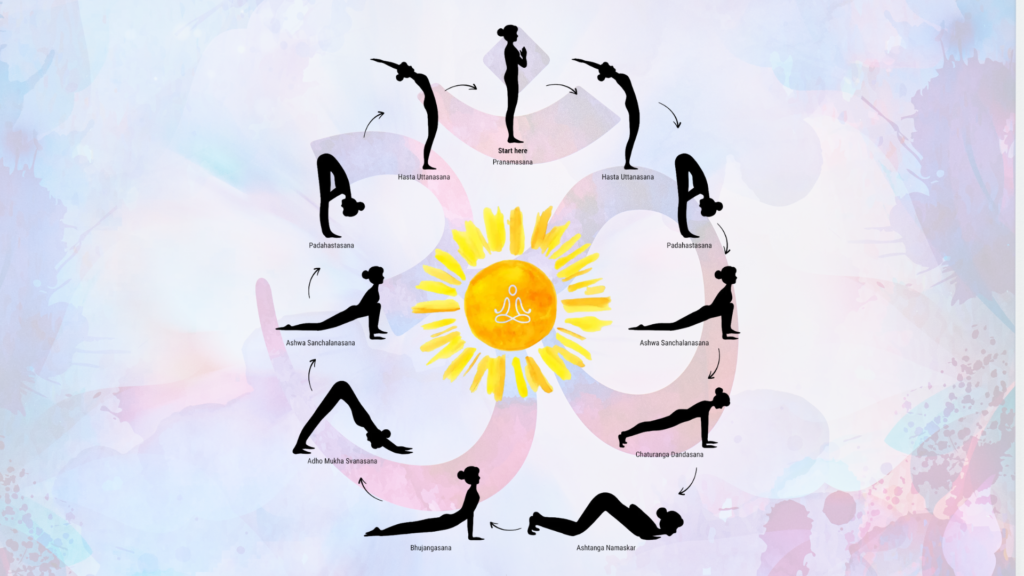
What I learned yesterday reshaped how I will ever do a Sun Salutation again. It is not 12 poses. It is five simultaneous experiences layered over one another.
Mind (Intention): Before you move, you set your intention. You invoke the sun. You ask to be cleansed of ignorance, to become more like it – impartial, whole.
Prana (Energy flow): Every pose in Suryanamaskara aligns with either an inhale or an exhale. This is not incidental. When the physical movement is synchronised to the breath, something extraordinary happens — the Solar Plexus, the body’s energy centre (mirroring the sun’s role for the planet), is activated. Energy flows. Clarity rises. Strength and resilience are built not just physically but at the level of the subtle body.
Breath and Movement: The breath leads. The body follows. This was perhaps my biggest personal revelation. I have always tried to control my breath around my movement, and it is exhausting and fruitless. When I let my movement follow my breath, there is ease. There is flow.
Asanas (Physical body): The 12 poses of a full Suryanamaskara sequence activate virtually every muscle group in the body. Strength is built in the holding. Flexibility comes from the stretching, not as a prerequisite to the practice, but as an outcome. As Nivriti put it plainly:
“You need strength before you can stretch. It’s like a rubber band that either breaks or looses its true form when stretched without tensile strength, one cannot stretch without building the strength and resilience. And Yoga is a practice that incorporates both.”
– Nivriti Gargya
Stamina is built in the cardiovascular flow of moving through all 12. This is why people do 100 Suryanamaskara and lose weight. But when done with breath, with intention, it becomes so much more than just a tool for weight loss or physical exercise.
Mind as Observer: BKS Iyengar explains in his book Light on Life how Yoga is practice where the physical body is the brain and the mind the observer and learner. This is perhaps the most quietly radical teaching in all of yoga. The mind’s job on the mat is to watch. Not to judge, not to push, not to compare. The body is doing its thing making itself durable and resilient. The mind observes, makes notes for next time, and lets go.
“By learning to let go of the need to control, you actually become more in control.” – Reflection
Why I Am Writing This
I am not a yoga teacher. Not yet. But I am on my way there and the reason is precisely this: too many practitioners have never been given this map. They have been handed beautiful poses and told to breathe, and they practice faithfully for years without ever understanding what they are building or why.
I want to help change that. I will be sharing what I learn as I learn it — raw, honest, imperfect — from one practitioner to another. Because the ancient wisdom of yoga is not the property of the advanced or the certified. It belongs to anyone willing to go to the mat with curiosity rather than performance.
What has been your experience of yoga – as performance, or as something deeper? I’d love to hear in the comments.

